Guardamar's Medieval Market


For three days only, a Medieval Market is set up on the street behind the church and stretches up to the base of the castle. This is the most beautiful and varied market so far in Guardamar--each booth is so unique! The Moors and Christians festival begins this weekend and this is one of the major events leading up to it. Everyone from town and all the tourists are here--our studio included!

The street that the Medieval Market follows is a residential street. Families open up their garage doors and invite friends to hang out. There's a section at the beginning that looks like it was set up by the locals, for the locals--there's a table with women selling home-baked treats, a table for kids to do arts and crafts, and a longer set of tables where elderly men and women were making lace. Yes, making lace! 

We couldn't communicate very well with them, but we found out that it takes a long time to make high quality lace. I believe it. Here are a couple of fans--definitely better than anything you can find at the dollar store! At the top left corner of the photo, you can see a little of the contraption that they use to make lace: wooden dowels with white thread wrapped around them to better control the thread. The thread is woven/knit/wrapped around dozens of pins. How the lace-maker knows what direction to weave the thread--that is a mystery. It looks so unbelievably intricate. 

At the start of the market is and hand-cranked flying swing set for the kids. I wanted to ride that so bad. 


There was such an eclectic and varied collection of booths! One brewed you a teapot of Moroccan tea and gave you a plate of Moroccan sweets. Many sold beautiful jewelry--woven, gold, silver, stainless steel, pearls, jewels. One sold hand-made shoes in bright, dyed leather. Another sold leather lace-up boots. One had a dazzling array of dried fruits and candies, while another had the freshest goat, sheep, and cow's milk cheese (I even got a sample!). One man wrote your name in Arabic letters. One booth sold miniature books. The most interesting (and tempting) booth was owned by one woman who sold her bakery goods by weight--there were chocolate-glazed donuts bigger than my face! And loaves of bread as large as an XL pizza in America! At the base of the castle there were a multitude of food and drink booths. At the center was a large fire-roaster, with chicken, sausages, pork, and vegetables. There was also a kebab stand (which we tried! It was delicious) and a cocktail booth. Plenty of seating for everyone to sit and eat their food. 

My favorite booth was owned by a woman who made glass beads and made beautiful jewelry out of them. She even demonstrated how she made beads with her little fireblower (not a technical term) and her sticks of glass. I ended up buying a beautiful ring from her!


I wish the Medieval Market lasted longer than three days. It's amazing to see the range of artisans and their wares, as well as to walk through slowly with everyone else in town around you.
Read more

Torrevieja: the Boardwalk and Chinese food

Sunshade device along the boardwalk
Naomi and I took a day trip to Torrevieja today. I was looking for a Barclays ATM so I could withdraw cash without paying any fees. We wanted to see the salt museum too, but it was closed.

Above is a sunshade. It's an awesome cantilelever, but it doesn't provide much protection from the sun, especially at high noon.

There's no beach in Torrevieja--that's why they have a boardwalk. It's all huge rocks, and the waves crash hard against them. We walked pretty far out. There are a variety of stalls that line the boardwalk, as well as restaurants and shops. It's a huge tourist area--there are even people climbing the rocks to touch the water and feel the spray.

Rocks, no beach
Torrevieja is known as a more international city--which might just mean that there are more Chinese people here. It's a bigger city than Guardamar and more British people live and have their holidays here. Chinese cuisine is rather popular among the British. I mean, who doesn't like Chinese food?!

Most restaurants in Spain offer a "Menu of the Day," which is similar to the lunches at the Pension: bread, first course, second course, a drink, and dessert and/or coffee. It was no different at the Chinese restaurant.

It was cheaper than other restaurants and the familiar flavor was comforting. Back in the US, I never really ate out at Chinese restaurants because the food is Americanized. When I did have Chinese food in a restaurant, I was always with my parents, who knew how to order healthier fare off the Chinese menu. The waitress at this restaurant in Torrevieja offered me the Chinese menu but I couldn't read it--and it was cheaper and simpler to order the Menu of the Day. I had to get Naomi to help me decide on what was safe to order. I got a salad with Asian-style dressing, chow mien, chicken chop suey, and a coffee. I even had leftovers to enjoy for later!

We found a Chinese grocery store near the bus station. There were so many foods--bok choy, tofu, salted duck eggs, mung beans, frozen pot stickers, spices, sauces... I ended up going on a mini shopping spree and getting bok choy, tofu, a barley soup mix that my mom has made before, the salted duck eggs, and umbrella cookies. Yum! (That's a photo of Banlangen, a drink powder that makes a tea good for drinking when you are about to get sick or have a fever.)
Banlangen at the Chinese food store
All in all, it was a successful trip!
Read more

Bike ride to Orihuela

On the road
This weekend, I decided to stay in Guardamar. I'm tired from traveling so much. And after seeing the Sagrada Familia, everything else seems to pale in comparison.

A bunch of people went to Morocco, some to Bilbao, some to Madrid. I took a bike ride to Orihuela!


It's a 36.73 mile bike ride, round trip. I rode along the Rio Segura. I ended up biking more than I planned because when I got to Orihuela, there was a bridge with train tracks blocking the bike path. I was expecting something like a highway exit straight into the city... boy was I wrong. I had to cut through an orchard of orange trees to the highway, and bike on the highway into the city!

It was so hot. I killed so many bugs just by smacking into them while riding. I stopped at the Mercadona (I've never been so happy to see a grocery store!) and walked around in there for a good 30 minutes because there was air conditioning. I left with Gatorade and 1.5 L of water for the trip back.

I didn't do much in Orihuela. I arrived around 1:30PM, so most places were starting to close for siesta. I found the Tourist Information and got a map. The cathedral was small but beautiful from the outside. I took a break in a gelato shop and drank horchata.

I started my ride back around 5PM. It was still really, really hot! I almost got lost trying to bike out of the city too. Every 15 minutes, I had to stop and sip some Gatorade. By the time I got back to the edge of Guardamar, the only thing keeping me going was the thought of dinner.

But I saw some great sights. The river, though mostly overgrown with plants, was very, very pretty. The mountains, as they got closer and closer, were majestic.

Panorama of a part of the river
About a block away from the bike rental shop, I stopped and tried to wipe myself down, but my bike was covered in sand from the riverbanks. I told the owner, "Orihuela, muy bueno!"

(Edit: On the Tuesday after this weekend, Alex was stopped by the bike shop owner, asking if Alex knew that one of his students rode all the way to Orihuela. His wife said it was too far! That made me smile.)
Read more

18: Don't bring a Mac!

Image Courtesy: Apple.com


We've been working a lot more on the computer these days. We had to model in Rhino, which is a task that's pretty intense for a computer to run.

Alex has made known before his dislike for and distrust of Mac computers. He says they're for sissies because everything has to look nice. I have to admit that yes, I am drawn to the aesthetics of Apple products, but it's not like the computers are lacking in terms of speed, storage space, et cetera.

There are a few disadvantages, though, to using a Mac when in architecture school. Most of the 2D and 3D tools that the industry uses, such as AutoCAD, do not run on Macs (or, like Rhino, have unfinished Mac versions). There are ways around this issue, but it's always a pain and takes longer to switch between the Windows side and the Mac side. It's just plain easier to use a Windows computer.

In Spain, specifically, Macs die off pretty quickly. It's still a mystery, but a couple of people's Macbooks have stopped working. I've been doing some informal investigating and from my observations, it seems like Macs tend to heat up way faster than Windows laptops. (The exception is Naomi's HP laptop, which is basically on fire all the time!) And since Spain's average summer temperature is much greater than Berkeley's, these laptops overheat easily. Not dealing with an overheating laptop properly can lead to its demise.

So don't bring a Mac! Or, be prepared to face the consequences.
Read more

Barcelona: Gaudi's City

Panorama inside the Sagrada Familia
The line for the Sagrada Familia was so long. I asked Naomi and Alaska if it was worth it to wait, and they wouldn't budge from the line. I went off in search of lunch, and by the time I came back with my pizza slices para llevar, we were already at the front of the line!

Needless to say, it was well worth the wait. The only reason why we left was because we were starving--if they sold snacks there, we could have stayed in the Sagrada Familia all day.

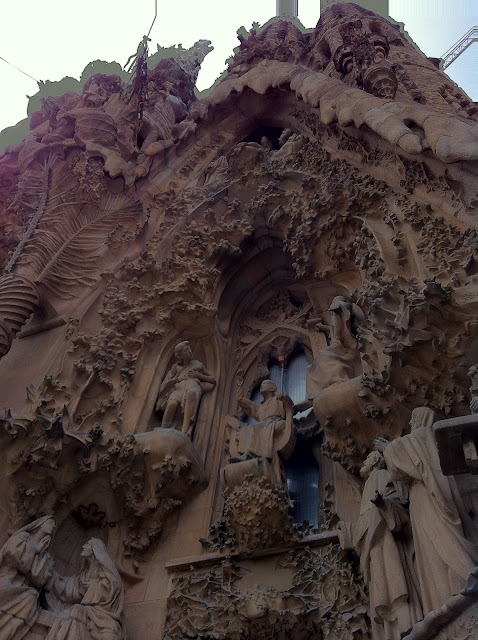
One of the facades of the Sagrada Familia

In the bookstore, I couldn't put down a biography of Antoni Gaudi's life. He refused payment for his work on the cathedral. He lived in a house in Parc Guell, uphill and quite a distance away from the Sagrada Familia, but walked daily to and from his house to the cathedral. He was inspired by forms in nature. He had to work the entire time he was in school to become an architect. 

What intrigued me the most was how he died. One day, an old man was struck by the train and no one could identify him. All the found in his pockets were a few coins and a handful of peanuts and raisins. They took him to the hospital for beggars, the homeless, and people who don't have family. It wasn't until Gaudi was about to die when the priest who was called in to read his last rites finally identified Gaudi as the architect of the Sagrada Familia! 

Though his cathedral was controversial at the time, Barcelona mourned his death. 

Construction continues on the Sagrada Familia to this day. It is hoped to be completed in 2026, on the 100-year anniversary of Gaudi's death. I'll have to go back to visit!

Going down the stairs of a tower in the Sagrada Familia
Outside facade of Casa Mila
Leaning columns at Parc Guell

Me climbing on the leaning wall at Parc Guell

Mosaics on the undulating benches at Parc Guell

Facade of Casa Batlo
Rooftop of Casa Mila

Read more

17: Book hostels carefully

Photo Courtesy: Ole Barcelona via hostelbookers.com
This is a photo of one of the rooms at
Ole Barcelona, the hostel that Naomi, Alaska, and I stayed at for our visit to Barcelona. Looks promising, right?

We were attracted by the low price for one night's stay (around 12 Euro, versus other hostels that were charging 20 Euros and up) as well as its proximity to Gaudi's Sagrada Familia (and the metro station too). But we were put off by the lack of reviews on the Hostelbookers website--there were only two very vague reviews that gave the hostel high ratings. We decided to give it a try anyway.

It was the worst hostel I've ever stayed at! I think I learned that sometimes it pays to choose the hostel that costs a bit more because odds are it will actually be a legitimate hostel.

This hostel had no sign. You press a buzzer to get in, but there's no camera for the receptionist to see who they're buzzing in. We "checked in" but were given no keys! There aren't any lockers, either. Our luggage was stored for the day in an unsecured, disorganized room. The next morning was not much better... The showerhead sprays out of the tub and onto the floor. There's no drain on the floor so the room starts to flood, basically. The sink takes minutes to drain. There was no water in the kitchen because they were fixing the first floor bathroom.

We held our breath and hoped for the best.

We ended up okay. Nothing lost or stolen, but we were in constant fear of some disaster happening and the hostel not taking any responsibility.

But we were treated to the wonderful architecture of Barcelona.

Read more
Powered by Blogger.
 

Studio vs. Siesta Design by Insight © 2009