Showing posts with label travel. Show all posts

20: Have a plan for packing


Sewing a patch with the Spanish crest onto the Hulk
I took a break from packing to sew this patch onto my backpack. Studying abroad in Spain has been an unforgettable experience. This patch sewn on the bag that will hold everything I own as I travel for the next 2.5 weeks is a symbol of the time I spent here, learning, seeing, experiencing.

With that said, packing is crazy. These two months here have made me forget how crazy it is to try to stuff everything back into a bag!

I have an important decision to make. I've already decided that I don't want to travel for 2.5 weeks with my laptop because I probably won't have much time to use it. Plus, it's heavy and takes up a lot of space. My laptop, I think, wins the award for Largest and Heaviest Laptop in Spain. Seriously.

So here are my options:
1) Mail is back home. Shipping ranges from 50 Euro to 200 Euro and up!
2) Have Alex ship it home for me because he has time to. Will have to pay him back.
3) Pack it in Naomi's checked luggage and get it back from her later.

Another important thing to think about is the mylars! Those three sheets of plastic document the process and evolution of my project. They're 24" x 36", so they won't fit in my backpack. I think a few people are shipping theirs back to Berkeley together, but again, the shipping costs are high. I could also send it back with Naomi.

I've had to throw out or give away things that I know I won't need anymore--my regular-sized sunscreen, lentils, some candy, the bowl and plastic boxes that I bought here. I'm going minimal again so I can pack light! I bought some Febreeze (yup, I found the name brand in Torrevieja) and rebottled it in a 33 mL spray bottle, and poured the laundry detergent into a 33 mL bottle as well. My liquids bag is about to burst.

It also pays to think about how you will travel afterwards. If I was taking the train to travel around Europe, I could have more luggage than just a backpack because the train system doesn't charge for extra bags (and you don't have to have a tiny bag for liquids!). If I was flying RyanAir, I would have to be very, very careful about the size of my bag. I'm flying EasyJet, though, and they're more lenient on bag sizes.

Plan ahead for packing and you will be alright! 
Read more

Torrevieja: the Boardwalk and Chinese food

Sunshade device along the boardwalk
Naomi and I took a day trip to Torrevieja today. I was looking for a Barclays ATM so I could withdraw cash without paying any fees. We wanted to see the salt museum too, but it was closed.

Above is a sunshade. It's an awesome cantilelever, but it doesn't provide much protection from the sun, especially at high noon.

There's no beach in Torrevieja--that's why they have a boardwalk. It's all huge rocks, and the waves crash hard against them. We walked pretty far out. There are a variety of stalls that line the boardwalk, as well as restaurants and shops. It's a huge tourist area--there are even people climbing the rocks to touch the water and feel the spray.

Rocks, no beach
Torrevieja is known as a more international city--which might just mean that there are more Chinese people here. It's a bigger city than Guardamar and more British people live and have their holidays here. Chinese cuisine is rather popular among the British. I mean, who doesn't like Chinese food?!

Most restaurants in Spain offer a "Menu of the Day," which is similar to the lunches at the Pension: bread, first course, second course, a drink, and dessert and/or coffee. It was no different at the Chinese restaurant.

It was cheaper than other restaurants and the familiar flavor was comforting. Back in the US, I never really ate out at Chinese restaurants because the food is Americanized. When I did have Chinese food in a restaurant, I was always with my parents, who knew how to order healthier fare off the Chinese menu. The waitress at this restaurant in Torrevieja offered me the Chinese menu but I couldn't read it--and it was cheaper and simpler to order the Menu of the Day. I had to get Naomi to help me decide on what was safe to order. I got a salad with Asian-style dressing, chow mien, chicken chop suey, and a coffee. I even had leftovers to enjoy for later!

We found a Chinese grocery store near the bus station. There were so many foods--bok choy, tofu, salted duck eggs, mung beans, frozen pot stickers, spices, sauces... I ended up going on a mini shopping spree and getting bok choy, tofu, a barley soup mix that my mom has made before, the salted duck eggs, and umbrella cookies. Yum! (That's a photo of Banlangen, a drink powder that makes a tea good for drinking when you are about to get sick or have a fever.)
Banlangen at the Chinese food store
All in all, it was a successful trip!
Read more

Bike ride to Orihuela

On the road
This weekend, I decided to stay in Guardamar. I'm tired from traveling so much. And after seeing the Sagrada Familia, everything else seems to pale in comparison.

A bunch of people went to Morocco, some to Bilbao, some to Madrid. I took a bike ride to Orihuela!


It's a 36.73 mile bike ride, round trip. I rode along the Rio Segura. I ended up biking more than I planned because when I got to Orihuela, there was a bridge with train tracks blocking the bike path. I was expecting something like a highway exit straight into the city... boy was I wrong. I had to cut through an orchard of orange trees to the highway, and bike on the highway into the city!

It was so hot. I killed so many bugs just by smacking into them while riding. I stopped at the Mercadona (I've never been so happy to see a grocery store!) and walked around in there for a good 30 minutes because there was air conditioning. I left with Gatorade and 1.5 L of water for the trip back.

I didn't do much in Orihuela. I arrived around 1:30PM, so most places were starting to close for siesta. I found the Tourist Information and got a map. The cathedral was small but beautiful from the outside. I took a break in a gelato shop and drank horchata.

I started my ride back around 5PM. It was still really, really hot! I almost got lost trying to bike out of the city too. Every 15 minutes, I had to stop and sip some Gatorade. By the time I got back to the edge of Guardamar, the only thing keeping me going was the thought of dinner.

But I saw some great sights. The river, though mostly overgrown with plants, was very, very pretty. The mountains, as they got closer and closer, were majestic.

Panorama of a part of the river
About a block away from the bike rental shop, I stopped and tried to wipe myself down, but my bike was covered in sand from the riverbanks. I told the owner, "Orihuela, muy bueno!"

(Edit: On the Tuesday after this weekend, Alex was stopped by the bike shop owner, asking if Alex knew that one of his students rode all the way to Orihuela. His wife said it was too far! That made me smile.)
Read more

Barcelona: Gaudi's City

Panorama inside the Sagrada Familia
The line for the Sagrada Familia was so long. I asked Naomi and Alaska if it was worth it to wait, and they wouldn't budge from the line. I went off in search of lunch, and by the time I came back with my pizza slices para llevar, we were already at the front of the line!

Needless to say, it was well worth the wait. The only reason why we left was because we were starving--if they sold snacks there, we could have stayed in the Sagrada Familia all day.

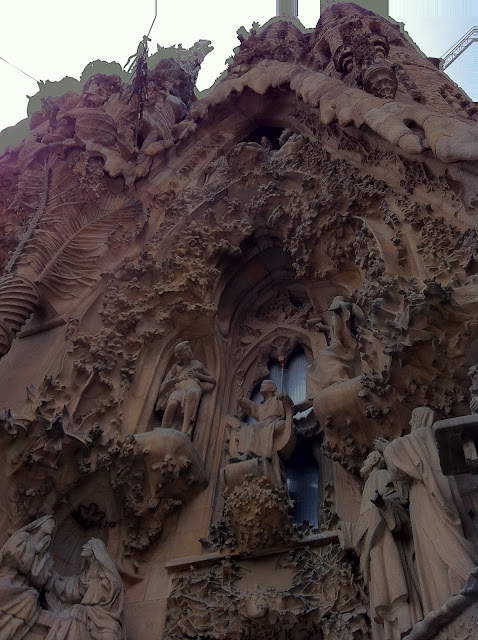
One of the facades of the Sagrada Familia

In the bookstore, I couldn't put down a biography of Antoni Gaudi's life. He refused payment for his work on the cathedral. He lived in a house in Parc Guell, uphill and quite a distance away from the Sagrada Familia, but walked daily to and from his house to the cathedral. He was inspired by forms in nature. He had to work the entire time he was in school to become an architect. 

What intrigued me the most was how he died. One day, an old man was struck by the train and no one could identify him. All the found in his pockets were a few coins and a handful of peanuts and raisins. They took him to the hospital for beggars, the homeless, and people who don't have family. It wasn't until Gaudi was about to die when the priest who was called in to read his last rites finally identified Gaudi as the architect of the Sagrada Familia! 

Though his cathedral was controversial at the time, Barcelona mourned his death. 

Construction continues on the Sagrada Familia to this day. It is hoped to be completed in 2026, on the 100-year anniversary of Gaudi's death. I'll have to go back to visit!

Going down the stairs of a tower in the Sagrada Familia
Outside facade of Casa Mila
Leaning columns at Parc Guell

Me climbing on the leaning wall at Parc Guell

Mosaics on the undulating benches at Parc Guell

Facade of Casa Batlo
Rooftop of Casa Mila

Read more

17: Book hostels carefully

Photo Courtesy: Ole Barcelona via hostelbookers.com
This is a photo of one of the rooms at
Ole Barcelona, the hostel that Naomi, Alaska, and I stayed at for our visit to Barcelona. Looks promising, right?

We were attracted by the low price for one night's stay (around 12 Euro, versus other hostels that were charging 20 Euros and up) as well as its proximity to Gaudi's Sagrada Familia (and the metro station too). But we were put off by the lack of reviews on the Hostelbookers website--there were only two very vague reviews that gave the hostel high ratings. We decided to give it a try anyway.

It was the worst hostel I've ever stayed at! I think I learned that sometimes it pays to choose the hostel that costs a bit more because odds are it will actually be a legitimate hostel.

This hostel had no sign. You press a buzzer to get in, but there's no camera for the receptionist to see who they're buzzing in. We "checked in" but were given no keys! There aren't any lockers, either. Our luggage was stored for the day in an unsecured, disorganized room. The next morning was not much better... The showerhead sprays out of the tub and onto the floor. There's no drain on the floor so the room starts to flood, basically. The sink takes minutes to drain. There was no water in the kitchen because they were fixing the first floor bathroom.

We held our breath and hoped for the best.

We ended up okay. Nothing lost or stolen, but we were in constant fear of some disaster happening and the hostel not taking any responsibility.

But we were treated to the wonderful architecture of Barcelona.

Read more

16: Take the train


Naomi, Alaska, and I decided to take the train from Valencia to Barcelona because it was cheaper than taking the bus. 

Let me tell you, it is worth it, even if it's not cheaper. 

There was so much leg room that I didn't know where to put my feet. No one sat next to me, so I could spread out comfortably because I am shorter than average, but I felt bad because the train was so clean and... legit. Space is a luxury on buses... on trains, it is standard. Even for coach. 


There is even a train car with a cafeteria. Restrooms are at either end of the car. The doors open with a wave of the hand. Movies play on the screen (in Spanish, of course). It is quiet and a smooth, smooth ride. More like a glide.  


And I heard that the trains in Spain are nothing compared to the trains in Italy. I can only imagine what first class is like!

If your budget allows, opt to take the train. Your body will be very happy. This is the most comfortable trip I have made thus far in Spain.
Read more

Valencia: The City of Arts and Sciences by Calatrava

On Assut d'Or, a bridge by Calatrava
The main attraction in Valencia, besides the city streets, is the collection of buildings designed by Santiago Calatrava, known as The City of Arts and Sciences. There is an aquarium, an underwater restaurant, a science museum, an IMAX dome theater, and an opera house. 

We took a tour of the Opera House, a grand building that looks like a helmet or some kind of an insect from the outside. The views are sweeping and the spaces are open. Calatrava, who is also an engineer, designed the spaces so that even if the walls were faced with indigo-colored ceramic tiles, the acoustics still worked beautifully. The structure of the building was visible and celebrated, accenting and complimenting the spaces. 

El Palau de les Arts Reina Sofia: The Opera House

Inside the Opera House lobby/event space

Inside the Opera House: main auditorium
There were a few other auditoriums but the main one was the most beautiful. 

The controversial Agora
The Agora was the most recent building to be opened. The project was so huge in scale and costs that politicians and the Valencian community thought it was a waste of money. With the current state of the world economy, not to mention Spain's economic plights, it's no surprise that there was controversy over the construction of the Agora. New buildings that are complex in structure and designed by a famous architect are guaranteed to be expensive.

It was beautiful to see Calatrava's architecture.

P.S. -- We had paella in the city where paella was invented! Thanks to Alex for the wonderful experience. We had one with chicken and seafood, one with just seafood, and the negro paella with squid ink. My favorite was the squid ink paella! See the photos below:


Read more

15: Use your travels for inspiration

Carnival within the riverbed in Valencia
We got our program for our final project in Altea. Our studio was split up into four groups at the beginning to document to Mercadillo. Alex and Pacia used the same groups to assign us four different programs: Water, Fire, Air, and Earth. My group was assigned the Earth program, which consists of a Center for Coastal Dune, River, and Tide Studies; a traditional shoe factory; a community olive oil press and exchange; and an Ecological Hotel. That's a complex program to manage for a summer studio!

Alex gave us some good advice as we were traveling to Valencia. Why not look around us for inspiration? How can we use our travels for our benefit? What strategies have been used before that can be implemented in our own designs?

One of the interesting things about Valencia is its nearby river. The water from the river has mostly been diverted so that no more water flows in the riverbed. However, the designers planned it such that they allowed enough water to still flow underground so that plants would still grow. So a park now sits in the riverbed and the plants never need to be watered because the water table is high enough that the plants can get all the water they need.

Very inspiring--that the river, which was once a life force in Valencia, is still a life force but more behind the scenes, and the riverbed has become a site for public use. Much to think about in the coming weeks for my final project.
Read more

Altea: The City in White


This is Altea. Alex says that this is what Guardamar would have looked like if it hadn't been flattened by an earthquake in 1829. 

Most of the buildings are painted with lime, so they are white. It is one of the last "white cities" in Spain. The lime protects the buildings from the salt of the sea. As you can see, the sea is just a walk away. 


We had to climb up, up, up to get to our hostel, which is in the part of Altea that is dense with houses, artisan shops, and restaurants. The cobblestones here are sharper, for some reason. 


We had the evening to ourselves so I took a walk around Altea. To the Northwest are sharp, tall mountains. I felt drawn to them because we have been so close to the sea for so long. But I started to walk East again to loop back toward the ocean. I passed by a music school, admiring the loud boom of the drums echoing through the hilly streets. The street facing the water was lined with restaurants. 

The beach here was made of large pebbles, not sand. They were probably still in the process of breaking down. As the waves crashed in, the pebbles made a loud rattling noise--like they were screaming, protesting against breaking down into sand. It sounded like thunder. 


At night, the view is breathtaking. Everything down the hill seemed to glow. The air was warm and there was a slight breeze. I sat down with some friends to listen to a few guitarists. Lots of people were out and about. It was a good night. 

Read more

Toyo Ito Relaxation Spa Ruins in Torrevieja


Torrevieja is a city larger than Guardamar and about a 20-minute bus ride away. It's along the coast as well but it lacks a beach. There's a boardwalk instead.

But we weren't interested in the boardwalk. We walked and walked and walked in the 5PM sun, scurrying from shady spot to shady spot, navigating roundabouts, and zigzagging our way from the city center to the edge of town. We passed so many Chinese restaurants. We walked through a neighborhood built for the British, which had no shady spots on the sidewalk because the British love the sun (that's why they vacation in Spain). I'm pretty sure we made it to the edge of town.

We come to a field overgrown with wild plants and see a black mass off in the distance. It's the ruins of a relaxation spa that Toyo Ito designed (here is more information). The mayor of Torrevieja a few years back commissioned several famous architects to build in the city. The relaxation spa was hated by the locals, and when the financial crisis hit and the project was more heavily scrutinized, it was found that the spa was being built on land protected as a nature preserve by the Valencian government (similar to a state government). Construction was halted and what was already built was abandoned.

We climbed into the foundation of the spa and found it eerie. We could tell that it had been burned and the glass had been shattered. This is a photo of me inside of the ruins. The twisting wood formed a shell shape that sat on a concrete foundation. I am standing on a steel floor deck. It was massive and humbling to be inside. It made me realize that even if I become a famous architects, it's still the luck of the draw that determines whether or not your projects will be realized in the end.
Read more

10: Take a Cab


Looking back on my spontaneous weekend trip to Madrid, I feel lucky that it was such a walkable city. Everything we wanted to see was in the city center and we could walk there in 20 minutes or less.

Since then, though, I've taken cabs and buses. I'd have to say that sometimes taking a cab is worth it! I used to think that busing or walking was always the best option, but there are many factors to consider.

In Granada, getting to the Alhambra looked like a relatively short walk... but most of it was a steep uphill climb and it was still hot out. The bus didn't take you up to the entrance of the palaces. Two other girls and I took a cab (seats 4 passengers max) and arrived 15 minutes earlier than everyone else. We were sweat-free too! We paid less than the bus fare to get straight to the entrance twice as quickly. Good deal!

The bus back from Alicante only runs at certain times. The last bus from Alicante back to Guardamar on weekdays is at 9PM, but festivities such as bonfires and parades usually don't start until after the last bus leaves. The earliest bus in the morning is at 7AM. In this case, it's probably worth the 50 euro cab ride back to the Pencion to sleep and be fresh and ready for the next day. Splitting the cost of a hotel room and then riding the bus for 45 minutes in the morning is also an option, but may add up to cost the same (or more) as a cab ride home.

But your mileage--and price--may vary. In Alicante, our class split up into groups to take cabs to the Centro de Tecnificacion (a sports center) designed by Miralles. This was also an uphill climb, but the meter seemed to be running fast! My cab got away with splitting 6.25 euro, but the other cabs that arrived after us paid 7 euro and up. Your cab luck depends on how well your driver can navigate roads, run yellow lights, and avoid obstacles.

Another option is to ask the driver if there is a flat rate to your destination, but that may not exist, or may be greater than what your actual fare ends up being.

I'm always down to walk everywhere to save a few euros. It adds up! But when I need a cab, I'll call one because it's worth it.
Read more

Mascleta Fireworks


During the first week of the
San Juan Festival in Alicante, fireworks are set off every day at 2PM in a public square. The sun is bright at that time of day so it's not about the lights--it's about the thunderous noise, the strength of sound. They are called the Mascleta fireworks, which translates to masculine fireworks. (During the second week, fireworks set off at night on the beach are all about the lights, and are called the feminine fireworks.)

We were about one block away from the fireworks. Every day is a different show and there is a competition on which show is the best. I could feel the sound in my chest--it was awesome.
Read more

9: Buses Are Never Comfortable


It's deceiving. The seats on these buses look so much more comfortable than the ones on the 51B, so the ride will be much more comfortable and smooth, right?

But factor in the fact that you'll be on this bus for more than five hours, it will make multiple stops, there's no bathroom on board, your backpack won't fit in the overhead bins, and the bus seems to have no shock absorbers, and you will change your mind.

On the bus back to Alicante from Madrid, the seats reclined in a very odd way. At one point, the man in front of me reclined his seat, and was able to look up and back a little and make eye contact with me. Awkward.

Leg room is always limited. Overnight buses are no better. You've got to twist and turn to avoid smashing your legs into the seat in front of you (or your backpack), and then you've got to somehow lean against the armrest or window, or risk falling into your seatmate's lap when you fall asleep.

It's definitely cheaper to travel by bus, and the bus network is really extensive. Buses are always on time. Book online or buy the ticket at the bus station and you're ready to go, even if you haven't printed out the ticket, as long as you have your Passport. It's easy to knock out within 10 minutes of getting on the bus because there isn't much to do, though there is often a movie playing on the little screens. On more expensive buses (called Supra, versus economy), you will find a bag with a snack and a water bottle on your seat.

But definitely be prepared for a bumpy ride and uncomfortable positions!
Read more

The Mezquita in Cordoba


Again, actually being in the dark, cool forest of arches within the Mezquita--a mosque-turned-cathedral--versus the 40 degrees Celsius outside was an experience that cannot be captured in images and text. Here's me, leaning on a column and looking cool! It was surreal being within the forest of arches that I had only seen in textbooks and slideshows. 

Read more

Granada: The Alhambra and more


Words and pictures cannot describe the experience of being in The Alhambra. We only had time for the Nasrid Palaces, but it was mind-blowing. I almost couldn't take it--I was freaking out!

Panorama within the Palaces, in a courtyard
Alex said that the whole project was about water. Historically, water had to be channeled from extremely far away to the Palace grounds, and the ruler wanted to show how powerful he was by building a grand Palace complex that is centered around water. Not only did he have enough water to survive, but he had enough water to show it off in beautiful courtyards and lush gardens with fountains and pools.

I think the project was, partly, a lot about making beautiful art and architecture. And making architecture students swoon (and have minor panic attacks) when they walk into the next room or courtyard.

Close-up shot of intricate detail
I really think this project was about light and shade, though--how to control light to make cool, dark spaces that feel constricted, or spaces that have light peeking through, or brightly lit spaces that feel open. It's about how to control the environment--as well as the user's path--so as to create specific experiences. How to use different degrees of enclosure to make different spaces.

Many times I found myself stepping from one dim room into a tight, cold corridor that twisted about itself--and then seeing the light hitting the wall at the end of the hallway. Then I would step out into an amazing courtyard, flooded with light, but still with enough shade to enjoy being outside. Something new and breathtaking was always around the corner, and it always alternated between light and dark.

It was beautiful.

Light coming in through a shade

Of course, water was everywhere. It was an undeniable force. I could hear it before I saw it, and I could feel it cooling me down. The project takes advantage of gravity to bring water down from the mountains into the Palace. The gutter system is ingenious as well as aesthetically pleasing.

Water flowing through the gutter system

After visiting the Alhambra, I was tired out--emotionally and physically. Good thing Alex treated us to tapas and tinto de verano, which translates to "red wine of the summer"--a mix of one part red wine and one part Fanta. And, of course, ice cubes (which is kind of a luxury in Spain)!

Tinto de verano, so refreshing

Read more

7: Food While Traveling

Tuna in sunflower oil
When traveling, it's not the best idea for your wallet or your health to eat out for every meal. And when you're walking around all day and constantly freaking out about beautiful architecture, three meals a day isn't enough.

I try to stick by what my former fitness teacher used to preach: eat complex carbohydrates, protein, and healthy fats at every meal or snack. Unfortunately, it's not that easy. You'll be limited by how much space you'll have in your bag or backpack, as well as lack of refrigeration. And you'll want to try the local cuisine too!

So here's my strategy: keep it cheap, easy, filling, and nutrient dense. Make use of all resources.

Because most hostels will have a kitchen with a stove, water, pots, a microwave, and a fridge, I make a stop at the local grocery store at my destination to buy food for breakfast. I stick to my wheat bran (for fiber) and yogurt with muesli, sometimes hard boiled eggs as well. For snacks, I am addicted to peanuts. For lunch or dinner, it's always cheap to get a loaf of bread or a baguette and eat it with tuna, cheese, or ham.

Where are the vegetables? Yeah, I'd like to know too!
Read more

The Mad City


Alex decided to make this weekend a 3-day weekend to accommodate travel, so Naomi and I spontaneously planned a trip to Madrid!

After climbing to the castle in Alicante, we took a bus to Madrid. We arrived in the evening and took the metro to our hostel, No Name Hostel right on Calle Atocha, one of the main streets in the heart of Madrid. We explored some of the city the first night, but we mostly planned out what to do for the next two days.

Saturday morning, we set out in the morning after a hostel breakfast (cornflakes, milk, and toast). We saw so much and everything was walkable! We saw everything on the Western side of Madrid. The Gran Via is the largest street in the city with multiple lanes; it is lined with shops like H&M, Nike, and McDonald's. Puerta del Sol is a large plaza, a very open public space, with a lot of history. Plaza Mayor is a closed square with many, many restaurants on its border (the photo is the plaza at night). We saw many palaces and churches that had amazing detail on the outside. I had a smoothie for lunch because I ended up not being able to decide which of the countless restaurants to dine at. Mercado San Miguel is an indoor marketplace of gourmet tapas; the building is intricately constructed with glass and steel. We had tapas in the La Latina neighborhood at a restaurant where the bartender did not speak English--but it was delicious! I love little foods with a glass of wine.

After tapas for dinner, we stopped by the supermarket to buy some snacks for Sunday to save some money (and to use the internet!). At night, we went out again. I found a bar that Hemingway used to frequent and had a hefeweizen there! Then we went to a chocolate and churros place--the hot chocolate is super thick so it's perfect to dip the churros into it. I ended up letting a chunk of churros marinate in the chocolate until it was infused with flavor.. yum! We slept well that night.

Sunday was museum day. It was amazing to see famous works of art up close and with succinct explanations. Most of the museums were East of our hostel. Our first stop of the morning, though, was a flea market called El Rastro. It's like the market in Guardamar, but much larger! It was on our way to the Reina Sofia, a huge museum that's free on Sundays in the morning. I got to see Guernica, my favorite painting by Picasso (and probably of all time). It was amazing to see the process and the sheer size of the painting. We were kicked out at 2:30pm so we didn't have time to see the entire museum. We then went to the Caixa Forum, which is another museum, but we mostly marveled at the green wall next to it. Then we went to a huge park near the Prado--it was really hot and there wasn't much shade, but a lot of people were there enjoying the weekend. It reminded me of a more planned version of Golden Gate Park. We went to the Prado Museum when it was free--it's filled with classical paintings with Christian themes. It was interesting to contrast all the modern art in the Reina Sofia with the realist and romantic paintings in the Prado.

For dinner, we went to Plaza Mayor to catch the sunset while eating tapas. We got to people-watch, which is always a treat! Some street performers were just setting up. After dinner, we went off in search of gelato, which I had never had before! I ended up getting the yogurt flavor, and it was super intense. Naomi got lemon and chocolate, and both were also very intense in flavor.

Tomorrow, we have a lot of time before our 3PM bus back home. Madrid has been awesome. We've walked so much in just two days... but it was worth it!
Read more
Powered by Blogger.
 

Studio vs. Siesta Design by Insight © 2009